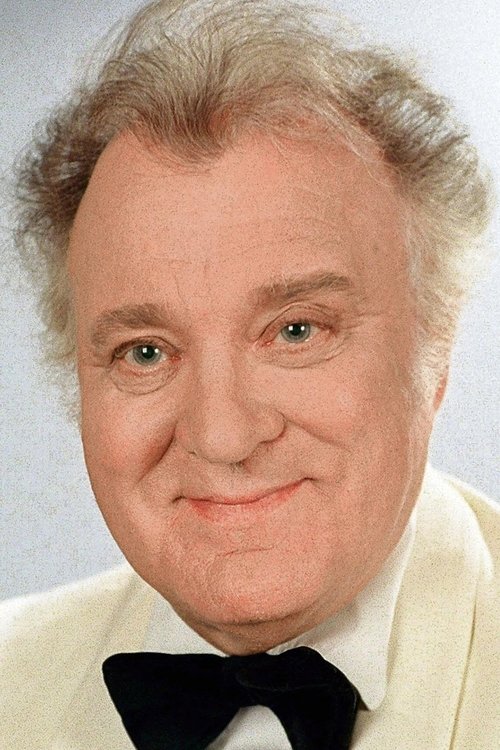
Nicolai Gedda
Harry Gustaf Nikolai Gädda, better known as Nicolai Gedda (11 July 1925 – 8 January 2017), was a Swedish operatic tenor. Debuting in 1951, Gedda had a long and successful career in opera until the age of 77 in June 2003, when he made his final operatic recording. Skilled at languages, he performed operas in French, Russian, German, Italian, English, Czech and Swedish, as well as one in Latin. In January 1958, he created the role of Anatol in the world premiere of Samuel Barber's Vanessa at the Metropolitan Opera. Having made some two hundred recordings, Gedda is one of the most widely recorded opera singers in history. His singing is best known for its beauty of tone, vocal control, and musical perception. Gädda, who later changed the spelling of his surname to Gedda, was born out of wedlock in Stockholm to a Swedish mother and a half-Russian father. He was raised by his aunt Olga Gädda and his adoptive father Michail Ustinov (a distant relative of Peter Ustinov), who sang bass in Serge Jaroff's Don Cossack Choir and was cantor in a Russian Orthodox church. Gedda grew up bilingual in Swedish and Russian, and from 1929 to 1934 when his family were living in Leipzig, Germany, he learned German. At the age of 5 Gedda took part in a vocal quartet in the orthodox church in the city. They returned to Sweden in 1934, and the boy attended Katarina Secondary School and the Södra Grammar School. In school he learned English, French and Latin, learning Italian on his own after leaving school. Gedda worked first as a bank teller in a bank in Stockholm and was obliged to support his parents financially; his sleeping arrangements were an alcove off the kitchen in their Stockholm apartment. One day he told a customer – a member of the Royal Opera House Orchestra – that he was searching for a good singing teacher, and the client recommended Carl Martin Öhman, a well known Wagnerian tenor from the 1920s, who is also credited with discovering Jussi Björling. Öhman was enthusiastic about Gedda and took him as a pupil, at the beginning without payment, because Gedda was at the time supporting his parents. Two months later his progress was such that he obtained a grant and then won the Christine Nilsson Prize. After a few months he obtained a scholarship and was later able to pay for Öhman's singing lessons. At the Royal Academy of Music and Opera School in Stockholm Gedda was in the class of Kurt Bendix and Ragnar Hyltén-Cavallius from 1950 to 1952. Gedda made his debut at the Royal Swedish Opera in Stockholm as part of the vocal quartet in the premiere of Der rote Stiefel by Sutermeister in November 1951. In April 1952, at the age of 26, Gedda made his triumphant debut in a principal role in Stockholm, performing Chapelou in Adolphe Adam's Le postillon de Lonjumeau, alongside Hjördis Schymberg. The 'Ronde du Postillon' in the opera, ("Mes amis, écoutez l'histoire"), is considered one of the most difficult tenor arias in all of opera, as it calls for a demanding high D from the soloist. An early appraisal of Gedda's singing was offered by Walter Legge, after first hearing him sing for the role of Dmitry in a planned recording of Musorgsky's Boris Godunov. ... Source: Article "Nicolai Gedda" from Wikipedia in English, licensed under CC-BY-SA.
Filmography (21)
 MOVIE★ 4.5Lady Macbeth of Mtsensk1992as Sergei (singing voice)
 MOVIE★ 7.5Candide1991as Governor / Vanderdendur / Ragotski
- TVMusik liegt in der Luft1991as Self - Singer
 MOVIE★ 7.7Boris Godounov1989as L'innocent (voice)
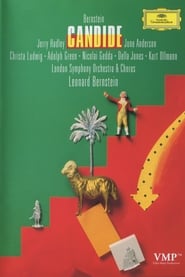 MOVIELeonard Bernstein - Bernstein - Candide1989as Self
- TVDa Capo1986as Self
- TVMelodien für Millionen1985as Self
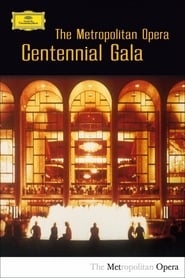 MOVIEThe Metropolitan Opera Centennial Gala1983as Self
- MOVIE★ 7.0Bühnenbild mit Dame1982
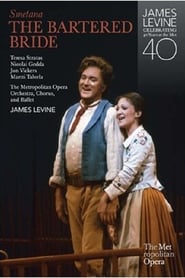 MOVIEThe Bartered Bride - The Met1978as Jenika
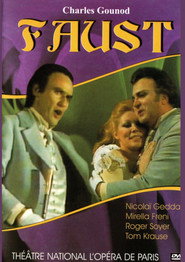 MOVIE★ 9.0Gounod: Faust1975as Faust
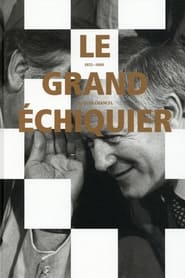 TV★ 8.0Le Grand Échiquier1972as Self
- TV★ 6.0Anneliese Rothenberger gibt sich die Ehre1971as Self
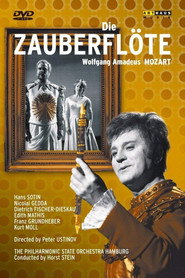 MOVIE★ 7.0Die Zauberflöte1971as Tamino
- MOVIE★ 7.0The World of Nicolai Gedda1971as Self
- TVLieder, Arien und Geschichten1964as Self
- TV★ 7.3Die Drehscheibe1964as Self
- TV★ 7.0Einer wird gewinnen1964as Self
 TV★ 8.0The Bell Telephone Hour1959as Self
 TV★ 8.0Aktuelle Schaubude1957as Self
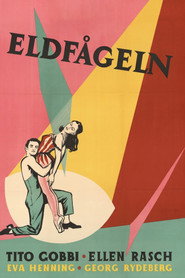 MOVIE★ 5.0The Firebird1952as Opera Singer